
Loading the game…
Play these too


What is Kızma Birader (Ludo)?
Kızma Birader (Ludo) is a Turkish Ludo board game with fair dice made by the Revoba studio. It is free to play in the browser, with no download or sign-up. Languages: Turkish, English. It is currently an early build.
Play Kızma Birader, the Turkish Ludo, in your browser: dice stats on screen, bots can't touch the dice. 2–4 players on one device, offline, free.
Kızma Birader (Ludo) screenshots
How to play Kızma Birader (Ludo)
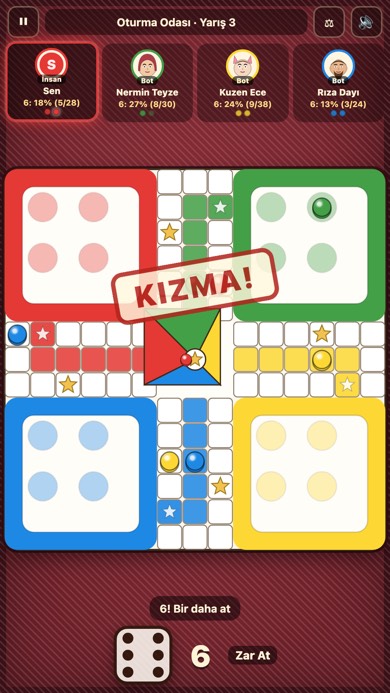
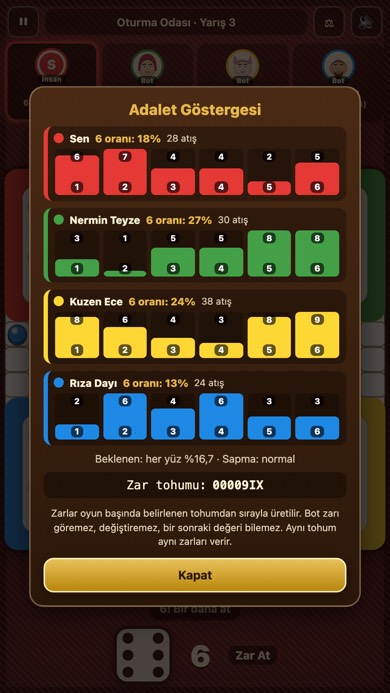
Tap the die. You need a 6 to bring a token out; rolling a 6 gives another roll. With all tokens home you get three tries. Tap the token you want to move; it advances by the roll. Landing on an opponent's token sends it home: "GOTCHA!". Star squares and start squares are safe; no captures there. Two of your tokens on one square form a block; opponents cannot pass or land on it. Go around the board and enter your colored path to the centre. The centre needs an exact roll; overshoot bounces back (or waits, by setting). Three 6s in a row lose the turn. In the tournament the first to finish wins the race; in free play the first to bring all four tokens home wins and the rest continue for ranking. During play, tap the fairness meter at the top to see everyone's dice distribution and the seed code.
Controls: Tap or click the die and the tokens; if only one move is possible the game plays it for you (can be turned off). With several people on one device the screen calls the next player and the phone goes around the table. On Android the back button pauses a race and returns to the menu from other screens.
Kızma Birader (Ludo) features
- Fair dice with on-screen stats and proof
- 2–4 players on one device, bots optional
- Turkish house rules, 13 options
- 6 tables, 30 races and a daily race
- Offline, no coins, no account
Tips for Kızma Birader (Ludo)
- Don't reflexively spend every 6 on a new token. If you already have tokens out and an opponent sits six squares ahead, capturing with the 6 is usually worth more than a new token, and you roll again anyway.
- Rest on star squares. With an opponent 1–6 squares behind you, each of its tokens has a one-in-six chance to hit you; move to a star or next to your own token (a block) when you can. The fairness meter is there so you think about your risk, not about the bot's luck.
- Spread your tokens as you approach home. Spinning in place with a single token waiting for the exact number wastes turns; with several tokens on the home path every roll does something. In the tournament the first to finish wins, so keep the trailing tokens moving too.
How fair dice work
Anyone who plays Ludo on a phone has heard the complaint: "the dice are rigged". Kızma Birader answers with a method, not a promise. At the start of every race a 32-bit seed is chosen; the dice come from that seed, in order, through a seeded generator. The same seed always gives the same dice, so the code shown at the end lets you replay the exact sequence or hand it to a friend and see who plays it better.
Who rolls is recorded only for statistics and never changes the value. During play the fairness meter shows, side by side, how often each player rolled 1 through 6 and their 6 rate; the expected share per face is 16.7%. When the bot chooses a move it sees only the board and the legal moves; the dice object is never passed to it. A unit test confirms that with the same seed the dice sequence stays identical whether bots or a random picker play. The daily race rests on the same idea: everyone rolls the same dice.
Turkish house rules and the tournament
Every household plays Kızma Birader a little differently, so this version turns the differences into options. Does a token need a 6 to come out, or does a 1 do? Three tries when all tokens are home? Do three 6s lose the turn? Are star squares safe, do two tokens form a block, does the centre need an exact roll, does an overshooting token bounce or wait? In free play you set all of these, plus the token count (2, 3 or 4).
The tournament teaches the rules table by table. The living room has classic rules and short two-token races; the garden allows exit on 1 or 6; the beach has no safe squares, so every square is dangerous; the coffee house makes blocks impassable, overshoots wait and captures roll again; the New Year table lets captures and finishes roll again; the championship brings the strongest opponents and a four-token grand final. Each race earns 1–3 stars and unlocks badges, tablecloths and token sets; nothing is for sale. Races take 5–10 minutes, half that in fast mode.
Where to play Kızma Birader (Ludo)
Kızma Birader (Ludo): frequently asked questions
Can I play Kızma Birader offline?
Yes. Once the page has opened in the browser it makes no network requests; it works the same on a bus or anywhere without signal.
Are the dice really fair? Doesn't the bot always roll a 6?
Dice are generated in order from a seed fixed at the start of the race; who rolls does not change the value. Every player's 1–6 distribution stays on screen. In a 60,000-roll test each face lands at about 16.7%.
Can the bot interfere with the dice?
No. When choosing a move the bot sees only the board and the legal moves; the dice object is never handed to it. A unit test shows the dice sequence is identical with the same seed whether bots or a random picker play.
How many players, and is there online play?
2–4 players on one device; some seats can be bots. There is no online mode, account or chat.
Which rules are there, and can I change them?
In free play you switch 13 rule options on and off: exit on 6, three tries, extra roll, three 6s, capturing, safe squares, blocks, exact finish, bounce or wait, token count and more. Tournament tables bring their own rules.
Is the game free? Any coins or purchases?
Free. No coins, money, wheels, chests or purchases; tablecloths and token sets unlock only by playing. Ads appear only at the end of a race, at most every second race.
Related genres: 2 player games · Arcade games